
The Power of Negative Space in Wedding Floral Design
Minimalism in floral design is often misunderstood.
It’s easy to assume it means fewer flowers, smaller arrangements, or simplifying for the sake of budget. But that’s not really what’s happening.
At its core, minimalism is about awareness. It’s about noticing how much space something needs in order to be seen clearly.
Negative space is what allows that to happen.
It creates separation. It introduces quiet. It gives each element a chance to exist without being crowded by everything around it. And when that kind of space is built into floral design, the entire experience shifts.
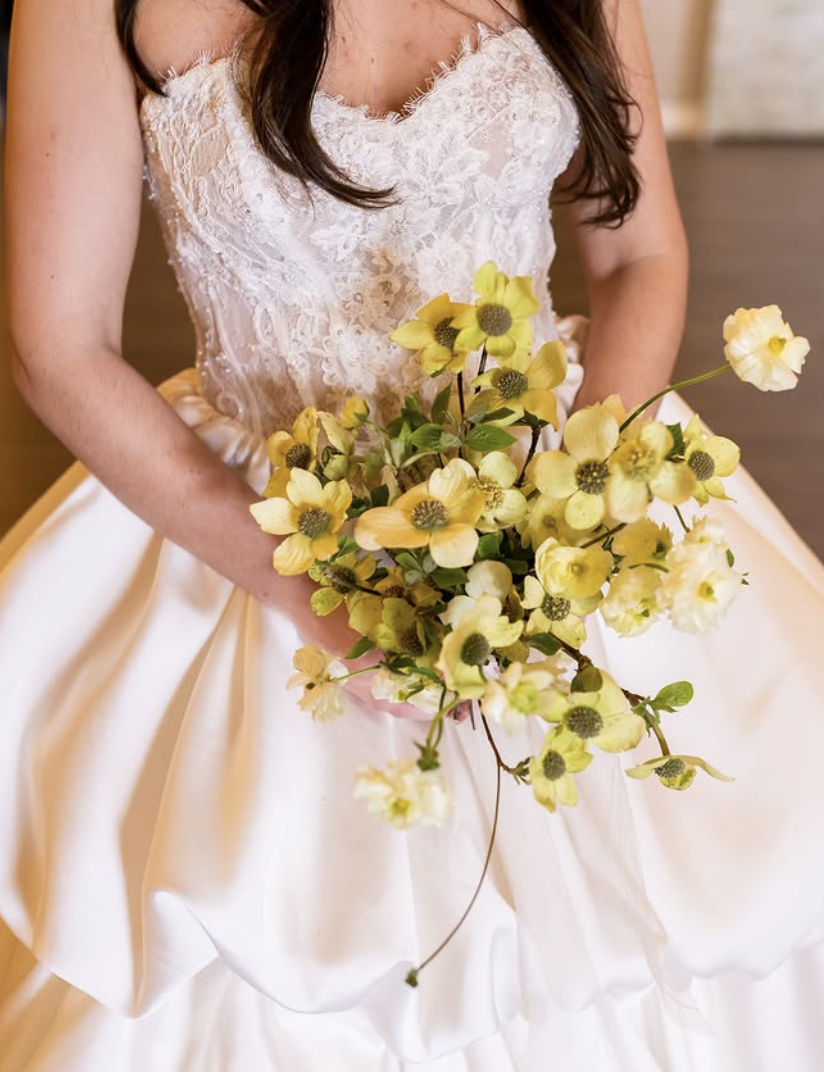
Image by Erin Witt Photography
What Happens When You Stop Filling Every Space
There is a natural instinct, especially in weddings, to fill. Tables feel like they need centerpieces. Installations feel like they should be abundant. Empty space can easily be mistaken for something unfinished.
But when everything is filled, nothing stands out.
Introducing space changes the way the eye moves through a design. It slows things down. It creates moments of pause where details can be noticed instead of overlooked. A single bloom begins to feel more deliberate. A branch becomes sculptural. Even the direction of a stem or the way it leans starts to hold meaning.
Instead of reading as a collection of flowers, the arrangement begins to feel like a composition, something that has been considered rather than assembled.
Why It Feels More Elevated
There is a quiet confidence in restraint. Designs that don’t try to do everything tend to feel more grounded and more intentional. They don’t compete for attention, and because of that, they often hold it more naturally.
This is part of why negative space is often associated with editorial or design-forward weddings. It isn’t about following a trend. It’s about creating clarity.
When visual noise is reduced, the remaining elements become stronger. The design feels more refined, not because there is more of it, but because what is there has been chosen with care.
Where You Notice It Most
Negative space doesn’t need to exist everywhere in order to be effective. In fact, it is often most impactful when it is used selectively.
In a ceremony setting, it might appear in the way florals frame the couple without enclosing them, allowing the moment itself to remain the focus. At the reception, it can show up in the openness of the tables, where guests are able to connect more easily without visual barriers between them.
In larger installations, negative space introduces movement. Instead of feeling dense or heavy, the design feels integrated into the environment, almost as if it belongs there rather than being placed on top of it.
These shifts are subtle, but they shape how the space is experienced.
The Role of Intentional Selection
Designing with negative space places more emphasis on what is chosen. When fewer elements are used, each one carries more weight, which makes details more noticeable.
Shape becomes more important. Texture becomes more important. The contrast between soft and structured elements begins to define the design rather than the number of flowers used.
This is where thoughtful selection matters most. A delicate bloom placed next to something more grounded can create depth. An airy element paired with something sculptural can introduce movement. These combinations allow the arrangement to feel layered without needing to feel full.
Designing With Space in Mind
Working with negative space changes the approach to floral design in a fundamental way. Instead of asking what else can be added, the question becomes what actually needs to be there.
That shift creates a different kind of result. The space feels calmer. The design feels more connected to its surroundings. And the overall atmosphere feels more intentional without feeling forced.
In the end, negative space is not about removing elements. It is about allowing the right ones to exist fully.
Because sometimes, what you leave out is what gives everything else meaning.
INTERESTED IN WORKING WITH MOONFLOWER DESIGN CO?